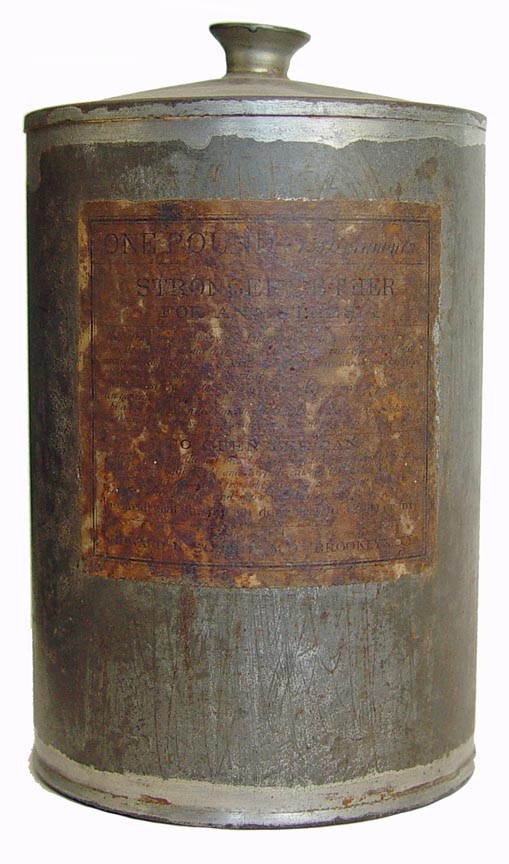
| 98. An American Civil War era antique ether tin put-up by Edward R. Squibb, M.D., Brooklyn, New York. The original label describes the contents as one pound of stronger ether for anaesthesia. This is a true 19th century ether tin from the period when Dr. Squibb, himself, ran the company. SOLD |
|
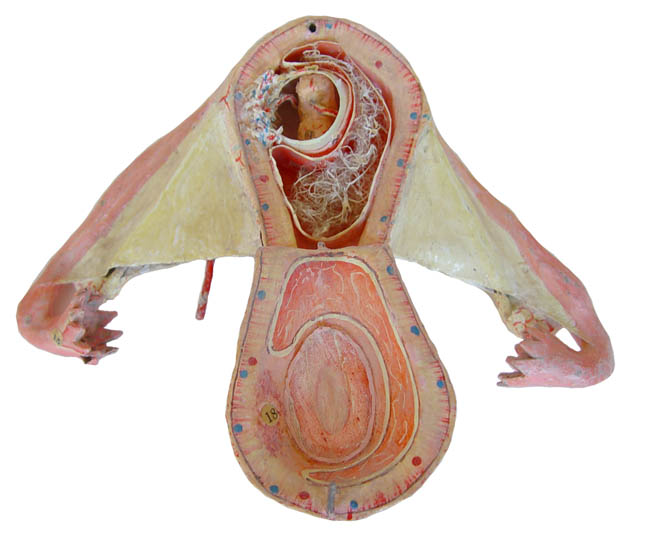
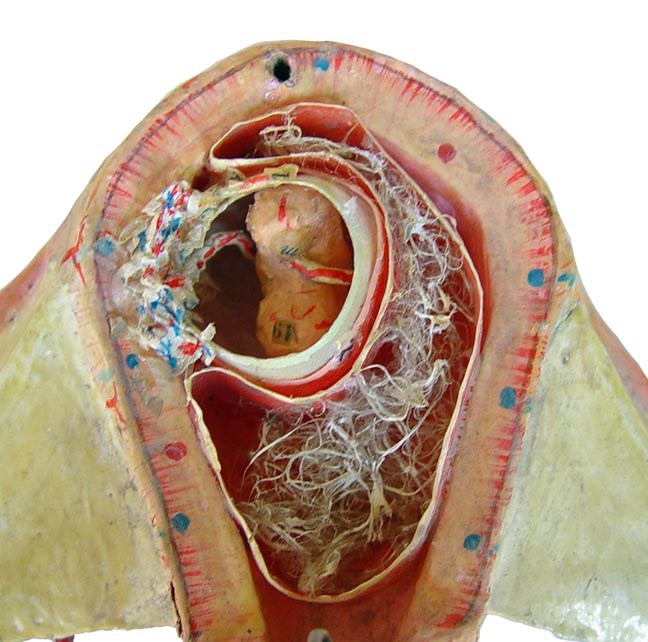
| 99. An Auzoux anatomical model of a human uterus with fetus at one month. $1,250 |
|
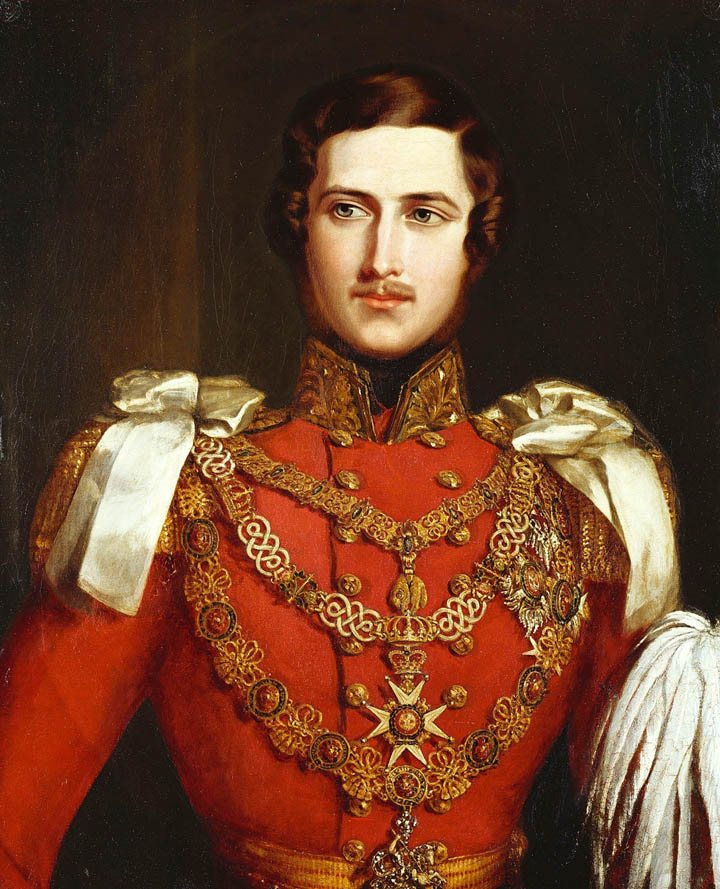
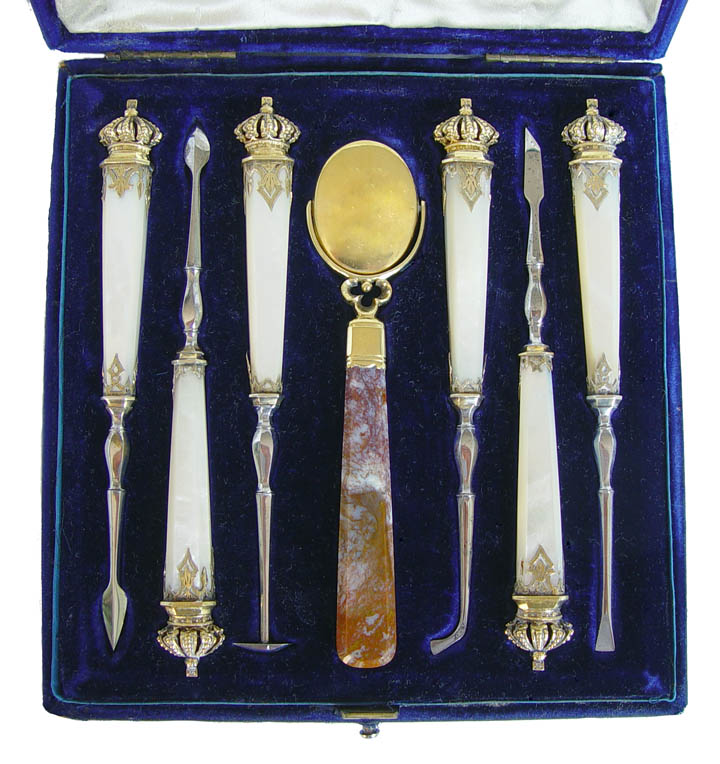
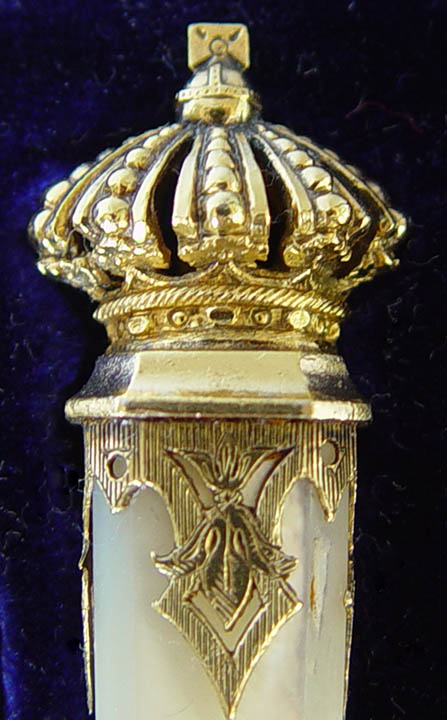
| 100. A resplendent antique dental instrument set made for the care of His Royal Highness Prince Albert of Saxe-Coburg and Gotha, Duke of Saxony (1819-1861), the husband of Queen Victoria. The set was crafted in England and dates to the 1840s. The 6 steel scalers have mother-of-pearl handles with gold ajouré and chased mounts. The mouth mirror is on a swing frame and has an agate handle. The Saxon crown, a major element in Prince Albert's coat-of-arms and regalia, is featured as a gold finial on each scaler. Though unmarked, the skillful workmanship of the Victorian Age goldsmiths Charles Rawlings and William Summers, London, fl. 1829-ca. 1860, is discernible. Prince Albert's senior dentists, from his marriage to Queen Victoria in 1840 to his death in 1861, were Alexander Nasmyth (1840-1846), Edwin Saunders (1846-1861), and James Robinson (1849-1861). Nasmyth became Surgeon-Dentist to Prince Albert in 1840. He and Saunders were later successive appointees to the post of Surgeon-Dentist-in-Ordinary to Queen Victoria and Prince Albert. Robinson was gazetted Surgeon-Dentist to His Royal Highness Prince Albert in 1849. Robinson, who on 19 December 1846 was the first to use anesthesia in a medical procedure in Britain, shared a common interest with the future Prince Consort in the then new field of anesthetics. Two similar dental sets, believed to have been used by Saunders, are linked to Queen Victoria and to the young Prince of Wales, the future King Edward VII. Queen Victoria's set, bearing Rawlings and Summers hallmarks and dated 1846, is on display at the National Museum of Dentistry, Baltimore, while the British Dental Association Museum, London, holds the set of the Prince of Wales. These three royal scaling sets are at the apogee of 19th century opulent dental instruments. SOLD |
|
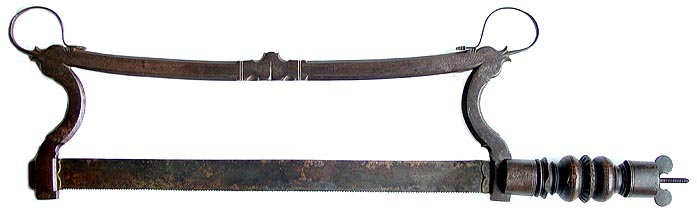
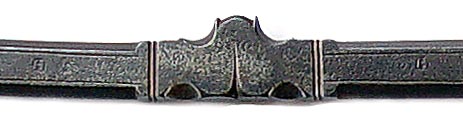
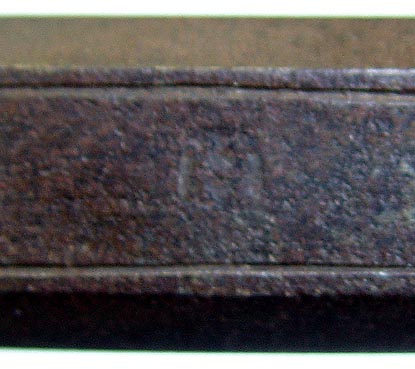
| 101. A very early capital amputation saw from Jacobean England. The saw is impressed with the H mark of Robert Hobbs, London, fl. c. 1606-1621. Instruments by Hobbs are believed to be the earliest extant English maker-marked surgical instruments. A nearly identical saw is illustrated in John Woodall, The Surgeon's Mate, 1639. This is precisely the saw that one would expect to have been used by Giles Heale, a member of the Barber-Surgeon's Company and the ship's surgeon on the Mayflower, and by Samuel Fuller, the surgeon of Plymouth Colony. 25" long. SOLD |
|
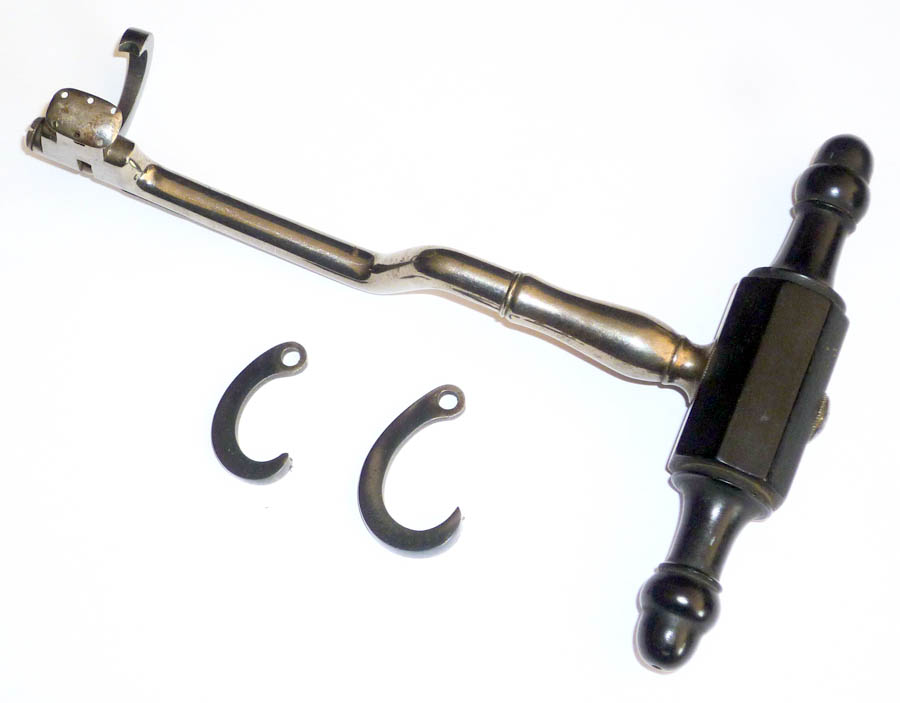
102. A well-made c. 1860 antique toothkey marked: J[ohn]. BIDDLE, NY. The handle is beautifully turned ebony and the three claws retain their original bluing. The swiveling bolster has 6 piercings by which padding may be sewn in place. $450 |
|
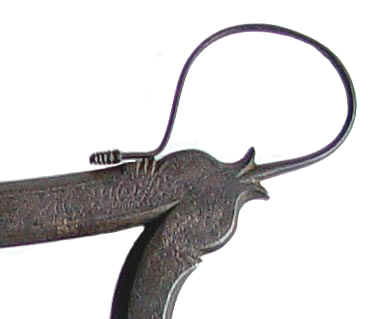
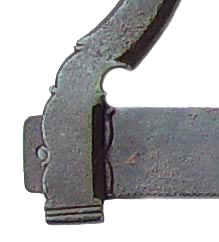
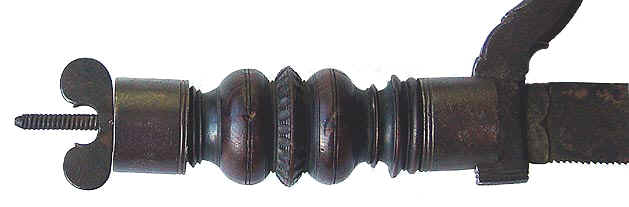
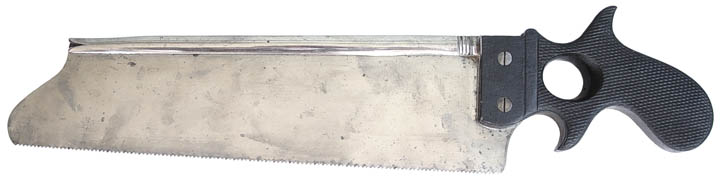
| 103. An early 1800s antique amputation saw with ebony handle. The spine terminates with a stylized serpent's head. A nearly identical saw is illustrated in Benjamin Bell, A System of Surgery. Vol. IV, PL. XCVIII, Fig. 1. Troy: O. Penniman, 1804. SOLD |
|
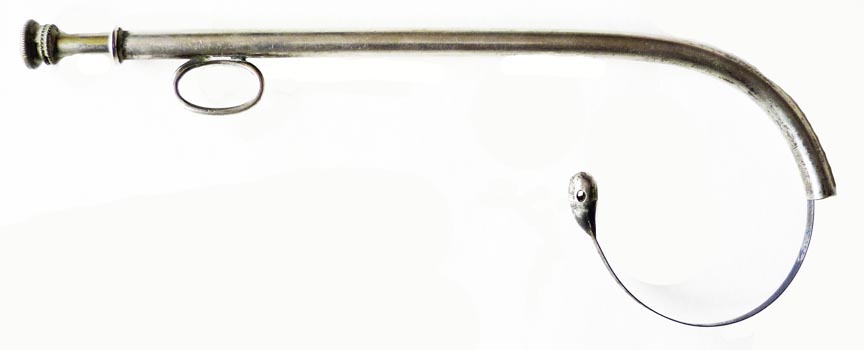
| 104. A 19th century Bellocq's cannula for epistaxis. The nasal instrument was designed by J.J. Bellocq (1732-1807), a French surgeon. It is made from silver and ribbon steel. For a description of the use of this instrument to plug the nares, please see this link. SOLD |
|
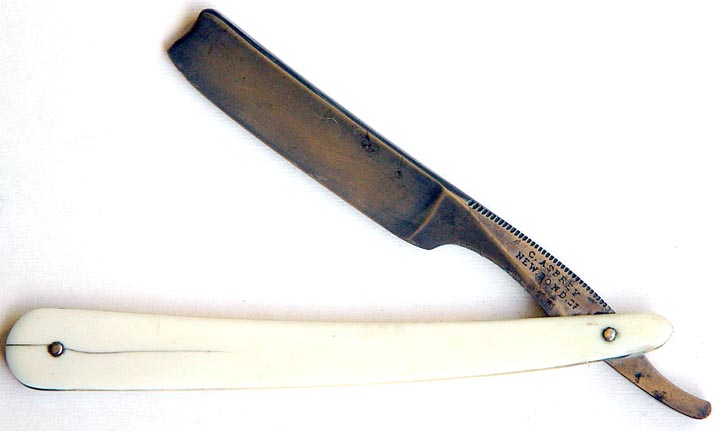
| 105. A Victorian antique straight razor by C. Asprey, New Bond Street, London. $75 |
|