Alex Peck Antique Scientifica
Sale Catalogue
Page 24
Below is a listing of a few medical and scientific antiques that are currently for sale. Please feel free to send an e-mail or to call (217) 348-1009 for additional details and to place an order.
Click on the thumbnails for enlargements and additional views.
All pictures and text are copyrighted 1982-2008 Alex Peck. All rights reserved.
SALE CATALOGUE PAGE 24
1. 2. 3. 4. 5. 6. 7. 8. 9. 10. 11. 12. 13. 14. 15. 16. 17. 18. 19. 20. 21. 22. 23. 24. 25. 26. 27. 28. 29. 30.
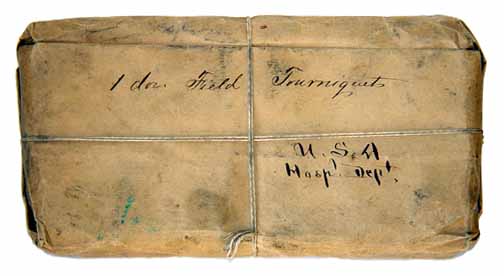
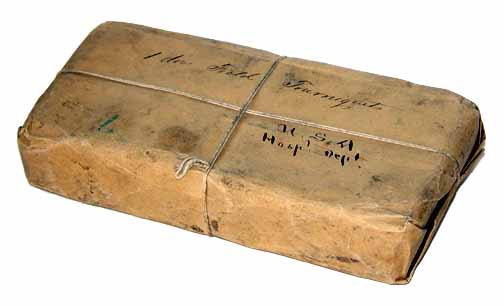
| 184. A very scarce and unopened package of one dozen field tourniquets put-up for the U.S. Army Hospital Department. Past observations indicate that each Civil War tourniquet inside is also wrapped and marked. A most desirable Civil War medical antique. |
|
| 185. A c. 1850 antique amputation saw by Evrard, London, with ebony-handle that folds-down on to the blade to make a compact instrument to case. | |
|
186. A c. 1860 Maw & Son, London, amputation set which has a history of ownership during the Civil War by Surgeon Waters in the 1st Texas Regiment, Hood's Texas Brigade, a unit most favored by General Lee and used by him as his shock troops. According to a note written in 1907 and accompanying the set, the set was captured...[by Charles W. Marvin]...and most likely taken from the 1st...Texas Regt. from the fact of a descriptive list in the case at the time of capture. Dr. Charles W. Marvin was a surgeon in the 26th Michigan. During the final week of the Civil War, the 26th Michigan, a part of the IInd Corps, was first in contact with Lee's forces at Amelia Courthouse on 4 April 1865 as Lee withdrew from Petersburg and Richmond. The Texas Brigade was assigned the role of protecting the rear of the retreating Army of Northern Virginia (it had done the same many times before, including the retreat from Gettysburg), and it was under continuous attack by the IInd Corps. Surgeon Marvin may have found Water's set in a medical supply wagon when the Confederate baggage train was captured at Sailor's Creek on the 6th. [I]n the case at the time of capture... was a just-released POW private's descriptive list (a form releasing the 1st Texas soldier from any monetary obligations to the army), and attached to this is his request for a disability discharge (his right leg was amputated after a wound suffered at Suffolk, Virginia, on 20 April 1863, and he was captured, in November 1863, while attempting to return to Texas) and a medical report. The medical exam was written-up by Henry W. Waters, the surgeon of the 1st Texas, on 11 March, when this unit was stationed on the eastern defenses of Richmond astride the Charles City Road. The request has various endorsements up the chain-of-command. The last to comment as Lee's A.A.G., on 16 March, and he denied the petition By order of Gen Lee. The documents would then have returned through the chain-of-command to Surgeon Waters, and they have remained with the set to this day. The Maw & Son name was in use only from 1860 to 1870.
|
|
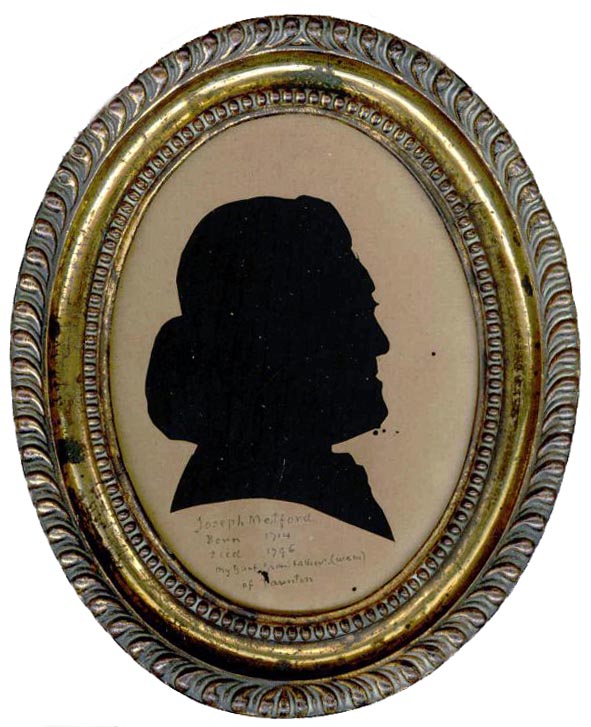
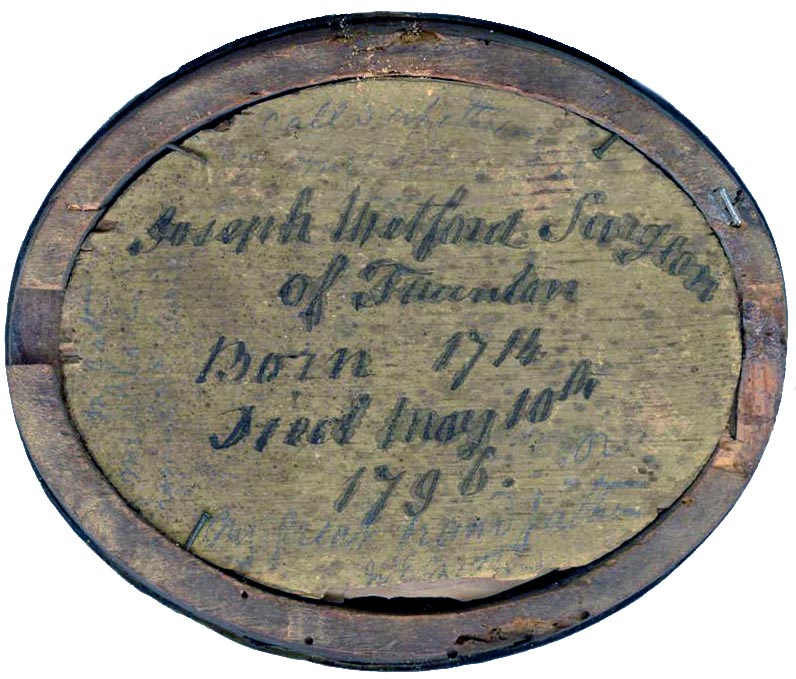
| 187. A late 18th century silhouette of a Georgian gentleman. The period inscription on the back reads: Joseph Metford Surgeon / of Taunton / Born 1714 / Died May 10th / 1796.
|
|
| 188. A very rare c. 1830 Tiemann part-surgical set with a large capital bow saw stamped: TIEMANN / N[EW] YORK. This is thought to be the earliest Tiemann mark. The single-piece ivory handle of the saw is of a pattern that was first introduced in the late 18th century. The two original rather long double-edged knives are signed: W. CARTER / RUE DE L'ODEON, indicating a previously unknown possible collaboration between Tiemann and a Paris maker. The ivory handles of the knives have a honeycomb cut, a pattern seen in other pre-1860 Tiemann sets. The tissue forceps is solid silver with tips of set-in steel. The case is unusual in that the bands on the rosewood exterior are German silver, not brass, and the interior is lined with a turquoise suede leather, not the typical velvet cloth. The lid to the interior compartment above the capital saw has a silver ring-lift, and the leather has tooling around the edge. The removable tray that once held the knives, tissue forceps, and other pieces is missing, though the instruments that were originally in the tray are clearly seen in their impression left in the lid's soft leather lining. The fabric that covers the case's bottom has a period pattern. All-in-all, this is a most remarkable and important, albeit incomplete, antique surgical set. SOLD |
|
| 189. An antique pharmacy pill machine (roller) made of mahogany and brass. | |
| 190. A c. 1860 tintype photograph of, apparently, a doctor or homeopath handing a medicine bottle to a patient. SOLD |
|
| 191. A c. 1862 albumen photograph signed Dr. A. S. Elwood, Surgeon 40th / Iowa Infantry. Dr. Azariah S. Elwood is shown in the full regalia of a newly appointed assistant surgeon. Note the plumed-Hardy hat with M.S. badge, the model 1840 Medical Staff sword, and the sash across his chest (worn in this manner to indicate that he is the officer of the day). The 40th Iowa was organized in Monroe, Iowa, and took part in Grant's Vicksburg Campaign. Besides Elwood's name and regiment on the front, the back has the period penciled inscription: Queen of the West / J.B. Hall / Ambrotype & Photographic Artist / Monroe, / Iowa. This is a terrific Civil War medical photograph. |
SALE CATALOGUE PAGE 24
1. 2. 3. 4. 5. 6. 7. 8. 9. 10. 11. 12. 13. 14. 15. 16. 17. 18. 19. 20. 21. 22. 23. 24. 25. 26. 27. 28. 29. 30.
Archives Articles Home Page Reference Books